
Sleep Apnea Secondary to Sinusitis
Sleep Apnea Secondary to Sinusitis: VA Disability Nexus Letters for Veterans
Many veterans suffer from chronic sinusitis after exposure to burn pits, dust, airborne irritants, environmental hazards, or other service-related respiratory stressors. For some veterans, sinusitis does not only cause congestion, facial pressure, headaches, drainage, and difficulty breathing through the nose. It may also contribute to or worsen obstructive sleep apnea.
If you are already service-connected for sinusitis and have been diagnosed with obstructive sleep apnea, you may be able to file a VA claim for sleep apnea secondary to sinusitis. To succeed, the claim generally needs more than a diagnosis. VA usually looks for medical evidence explaining how the service-connected sinusitis caused, contributed to, or aggravated the sleep apnea.
A strong medical nexus letter can help bridge that gap.
At Brightview Psychiatry Solutions, Dr. Allen provides independent medical nexus letters for veterans seeking to support VA disability claims, including claims involving obstructive sleep apnea secondary to sinusitis, rhinitis, PTSD, depression, anxiety, chronic pain, and other service-connected conditions.
Connect with Dr. Allen
Dr. Allen has years of experience writing nexus letters for initial claims, supplemental claims, and her work has even been featured in Veterans Board of Appeal Cases.
Claiming Sleep Apnea Secondary to Sinusitis
Can Sleep Apnea Be Secondary to Sinusitis?
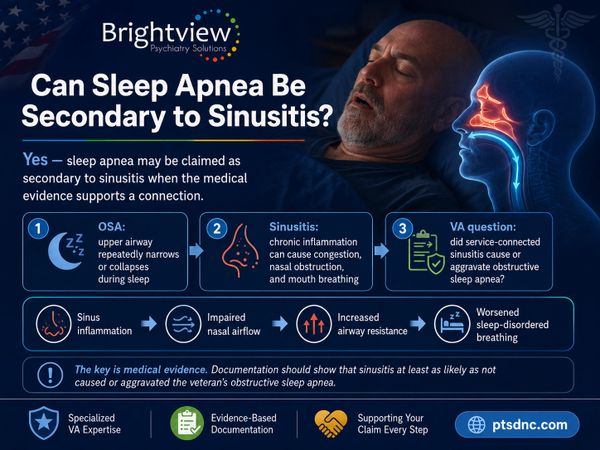
Yes, sleep apnea may be claimed as secondary to sinusitis when the medical evidence supports a connection.
Obstructive sleep apnea, often called OSA, occurs when the upper airway repeatedly collapses or becomes blocked during sleep. This can cause loud snoring, witnessed pauses in breathing, choking or gasping at night, morning headaches, non-restorative sleep, daytime fatigue, poor concentration, irritability, and cardiovascular strain.
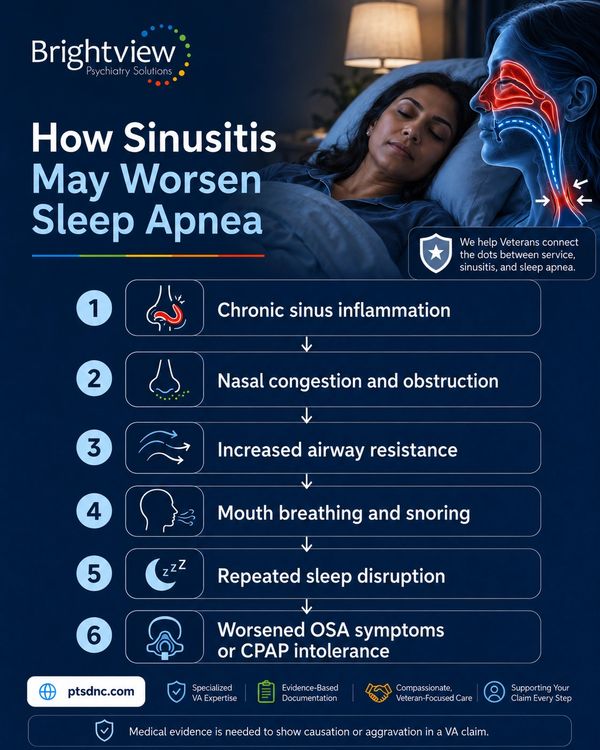
Sinusitis involves inflammation of the sinus passages. Chronic sinusitis can lead to ongoing nasal congestion, postnasal drip, mucus obstruction, facial pain, impaired nasal airflow, and difficulty breathing through the nose. When nasal airflow is persistently impaired, the veteran may experience increased airway resistance during sleep, greater mouth breathing, worsened snoring, sleep fragmentation, and difficulty tolerating CPAP therapy.
For VA purposes, the key question is not simply whether sinusitis and sleep apnea coexist. The key question is whether the veteran’s service-connected sinusitis at least as likely as not caused or aggravated the veteran’s obstructive sleep apnea.
How Sinusitis May Contribute to Obstructive Sleep Apnea
Sinusitis and obstructive sleep apnea involve different parts of the respiratory system, but they can still be medically related in certain veterans. The nose, sinuses, throat, and upper airway work together during breathing. When chronic sinusitis causes ongoing nasal congestion, inflammation, drainage, or impaired airflow, it may place additional stress on the upper airway during sleep.
For some veterans, chronic sinus symptoms can make nighttime breathing more difficult. Nasal obstruction may lead to increased mouth breathing, louder snoring, disrupted sleep, or difficulty maintaining steady airflow while asleep. Sinus-related inflammation and congestion may also worsen sleep quality, contribute to nighttime awakenings, and make symptoms such as fatigue, morning headaches, poor concentration, and irritability more severe.
Sinusitis may also affect treatment for sleep apnea. Veterans who use CPAP, APAP, or BiPAP therapy may have more difficulty tolerating treatment when they have chronic nasal congestion, dryness, pressure discomfort, mask leaks, or the sensation that they cannot breathe comfortably through the nose.
In VA disability claims, the question is not simply whether a veteran has both sinusitis and sleep apnea. The more important question is whether the veteran’s service-connected sinusitis has at least as likely as not caused, contributed to, or aggravated the veteran’s obstructive sleep apnea. In some cases, sinusitis may not be the original cause of sleep apnea, but it may still worsen the severity of symptoms, interfere with treatment, or increase the overall functional impact of the condition.
Because every claim is different, this relationship should be evaluated based on the veteran’s medical records, symptom history, sleep study findings, treatment response, and other relevant risk factors. Dr. Allen takes all of these factors into consideration when writing sleep apnea nexus letters.
VA Secondary Service Connection for Sleep Apnea Due to Sinusitis
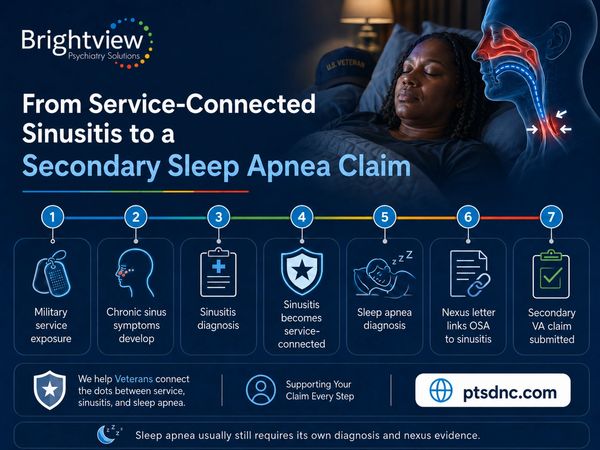
To establish sleep apnea secondary to sinusitis, veterans generally need three types of evidence:
1. A Current Diagnosis of Obstructive Sleep Apnea
VA will typically require a formal diagnosis of sleep apnea, often confirmed by a sleep study. This may include an in-lab polysomnography study or a home sleep apnea test. Documentation should identify the type and severity of sleep apnea and whether a breathing assistance device such as CPAP, APAP, BiPAP, or an oral appliance has been prescribed.
2. A Service-Connected Primary Condition
For this type of secondary claim, the primary condition is usually chronic sinusitis. The veteran should already be service-connected for sinusitis or be pursuing service connection for sinusitis at the same time.
Sinusitis may be directly service-connected or, for some veterans, presumptively service-connected based on qualifying service and exposure to particulate matter, burn pits, or other airborne hazards.
3. A Medical Nexus Between Sinusitis and Sleep Apnea
The nexus is often the most important part of the claim. A nexus letter should explain why the veteran’s sleep apnea is at least as likely as not proximately due to, the result of, or aggravated by the service-connected sinusitis.
A strong nexus letter should not rely on a generic statement such as “sinusitis can cause sleep apnea.” Instead, it should explain how the veteran’s specific sinusitis symptoms, medical history, sleep apnea diagnosis, treatment records, risk factors, and functional impairments fit together medically.
Causation vs. Aggravation: Why This Matters
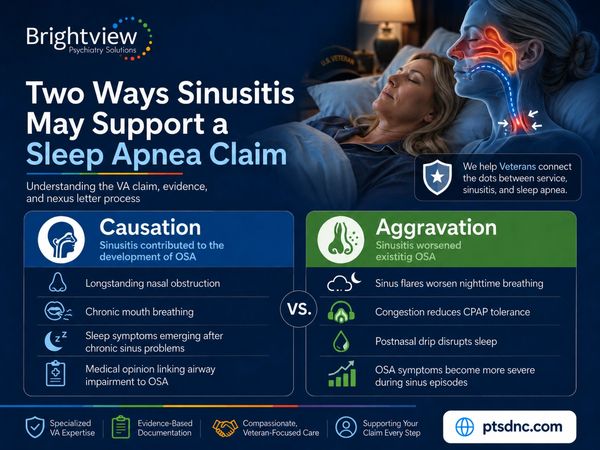
There are two major ways to argue sleep apnea secondary to sinusitis. After reviewing your medical history, Dr. Allen will be able to determine which approach to take in your nexus letter:
Causation
Causation means the service-connected sinusitis directly contributed to the development of obstructive sleep apnea. This argument may be appropriate when the veteran had longstanding sinus symptoms, chronic nasal obstruction, mouth breathing, snoring, witnessed apneas, and sleep disruption before or around the time OSA was diagnosed.
Aggravation
Aggravation means the veteran’s sinusitis made the sleep apnea worse, even if other factors also contributed to the original development of OSA. This may apply when chronic sinusitis worsens nighttime breathing, increases awakenings, makes PAP therapy harder to tolerate, or increases the functional severity of the veteran’s sleep apnea symptoms.
In many VA claims, aggravation is an important theory because VA may focus heavily on other risk factors. A strong medical opinion should explain whether sinusitis caused the OSA, aggravated the OSA, or both.
Service Connection for Sleep Apnea Denied, What to Do Next?
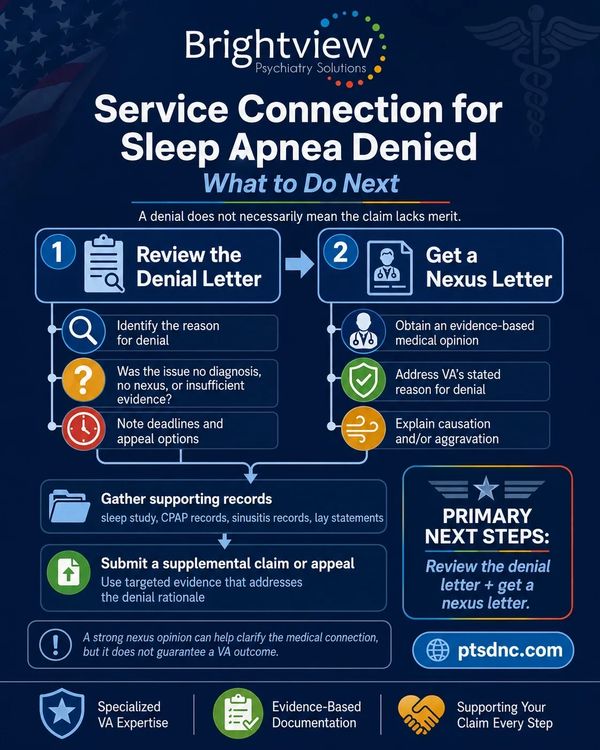
How a Nexus Letter Can Help Denied Claims
The VA may deny sleep apnea secondary to sinusitis claims when the evidence does not clearly explain how the veteran’s sinusitis is medically connected to obstructive sleep apnea.
Common reasons for denial include:
- The VA acknowledges the sleep apnea diagnosis but states there is no medical nexus.
- The VA concludes that obesity, age, anatomy, or another risk factor is the more likely cause.
- The VA finds that sinusitis and sleep apnea are separate conditions without causation.
- The veteran submits medical records but no professional opinion or nexus letter explaining the connection.
- The nexus letter opinion is too brief, conclusory, or unsupported by medical reasoning.
- The claim argues causation but does not address aggravation.
- The examiner fails to discuss chronic nasal obstruction, nighttime breathing impairment, CPAP intolerance, or worsening symptoms.
If your claim for obstructive sleep apnea has already been denied, it is important to pay close attention to the date on your VA decision letter. In many cases, a veteran may file a Supplemental Claim within one year of the denial and submit new and relevant evidence in support of the claim.
Doing so may help the veteran continuously pursue the claim and may help preserve the earliest possible effective date for back pay.
A nexus letter from Dr. Allen can serve as new and relevant evidence for a Supplemental Claim when it addresses the reason the VA denied the claim and provides a clear, individualized medical explanation. A well-prepared nexus letter can help respond to VA’s concerns by explaining the medical relationship between sinusitis and obstructive sleep apnea.
Because the one-year deadline can be important, veterans who have received a denial should not wait until the appeal window is close to expiring before seeking medical review.
Supporting Evidence For Sleep Apnea Secondary to Sinusitis
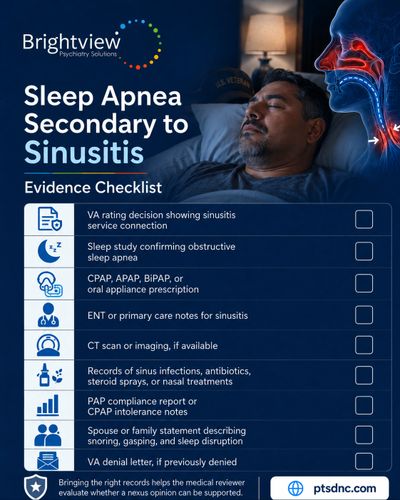
Sleep Apnea Evidence
- Sleep study results
- Diagnosis of obstructive sleep apnea
- CPAP, APAP, BiPAP, or oral appliance prescription
- PAP compliance reports
- Records documenting mask intolerance, congestion-related CPAP problems, or pressure intolerance
- Reports of snoring, choking, gasping, witnessed apneas, or daytime fatigue
Sinusitis Evidence
- VA rating decision showing sinusitis is service-connected
- ENT records
- CT scans or imaging of the sinuses
- Diagnosis of chronic sinusitis or chronic rhinosinusitis
- Records of recurrent sinus infections
- Antibiotic use
- Steroid sprays, antihistamines, decongestants, nasal rinses, or other treatments
- Documentation of nasal obstruction, postnasal drip, purulent drainage, headaches, facial pain, or sinus tenderness
- Surgical history, if applicable
Lay Statements
Lay statements can be helpful when they describe observable symptoms over time. A spouse, family member, roommate, or fellow service member may be able to describe:
- Loud snoring
- Pauses in breathing during sleep
- Gasping or choking at night
- Worsening sleep during sinus flare-ups
- Chronic congestion and mouth breathing
- Daytime fatigue
- Irritability or poor concentration
- Problems using CPAP because of nasal blockage
Sleep Apnea Nexus Letter
A medical nexus letter can tie the evidence together and explain why the veteran’s obstructive sleep apnea is medically related to service-connected sinusitis. Many veterans already have all of the important supporting evidence listed above. Some veterans even submit medical journal articles or research studies.
However, the VA may still deny the claim if the evidence does not include a clear medical opinion connecting those facts. The VA may find that the evidence is too general unless a qualified medical professional explains how the medical literature applies to the veteran’s specific history.
That is the role of a nexus letter. A well-prepared nexus letter does more than simply state that sinusitis and sleep apnea can be related. Dr. Allen's nexus letters review the veteran’s records, considers the timeline of symptoms, discusses relevant medical literature, addresses other risk factors, and explains how the veteran’s service-connected sinusitis at least as likely as not caused, contributed to, or aggravated the veteran’s obstructive sleep apnea.
In other words, Dr. Allen's nexus letter will connect the dots. It helps bridge the gap between the veteran’s diagnosis, service-connected condition, medical records, lay evidence, and the scientific research. Without that individualized explanation, the VA may acknowledge that the veteran has sleep apnea and sinusitis but still deny the claim because the medical connection has not been clearly established.
Sleep Apnea Secondary to Sinusitis and Obesity
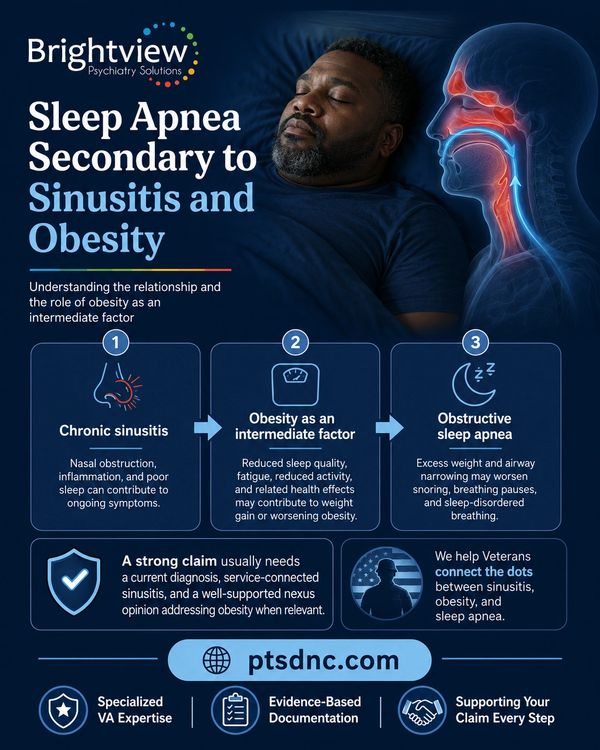
More Than One Theory of Entitlement Can Exist
The VA often cites obesity as a risk factor when denying claims for obstructive sleep apnea. While obesity is a known risk factor for OSA, it does not automatically rule out service-connected sinusitis as a contributing or aggravating cause. Many medical conditions have more than one contributing factor, and sleep apnea is no exception.
Under VA regulations, a disability may be service connected on a secondary basis when it is proximately due to, the result of, or aggravated by a service-connected condition. This means a veteran may have more than one theory of entitlement. For example, the evidence may support that service-connected sinusitis contributed to the development of OSA, worsened pre-existing OSA, or aggravated the overall severity and functional impact of the condition.
Obesity may also be relevant in a different way. The VA’s Office of General Counsel has recognized that obesity may serve as an “intermediate step” between a service-connected disability and a claimed condition. In practical terms, this means that if a service-connected condition contributes to weight gain or obesity, and that obesity then contributes to obstructive sleep apnea, the veteran may still have a medically supportable secondary service connection theory. This type of argument requires careful medical analysis and should be supported by the veteran’s specific records.
For example, a veteran with service-connected sinusitis may also have other service-connected conditions that limit activity, disrupt sleep, worsen fatigue, contribute to medication-related weight gain, or make weight management more difficult. In that situation, obesity should not simply be treated as a reason to deny the claim. Instead, the medical opinion should evaluate whether obesity is an independent cause, a contributing factor, or an intermediate step connected to one or more service-connected conditions.
A strong nexus letter should address obesity directly and carefully. It should explain whether the veteran’s sinusitis caused OSA, aggravated OSA, worsened PAP tolerance, increased symptom burden, or contributed to functional impairment despite the presence of other risk factors. When appropriate, it may also explain whether obesity itself was caused or aggravated by service-connected conditions and whether obesity served as an intermediate step in the development or worsening of OSA.
The key issue is not whether the veteran has risk factors. The key issue is whether the medical evidence shows that a service-connected condition was at least as likely as not part of the causal or aggravating pathway. A well-prepared nexus letter can help VA understand how the veteran’s sinusitis, obesity, sleep apnea, treatment history, and other medical factors fit together in the individual case.
How A Nexus Letter from Dr. Allen Can Help
Why Dr. Allen Is Especially Qualified to Write This Nexus Letter?
Not all nexus letters are the same. Veterans often need more than a short conclusory statement saying that one condition is related to another. A persuasive nexus letter should explain the medical reasoning, apply the science to the veteran’s specific facts, and address the issues VA often raises when denying these claims.
Dr. Allen is especially qualified to provide this type of opinion because she is a physician, a psychiatrist, a former VA C&P examiner, and a former Social Security Disability examiner. This background gives her a unique understanding of both the medical issues involved and the evidentiary standards that often matter in disability claims.
For sleep apnea secondary to sinusitis, Brightview Psychiatry Solutions reviews the veteran’s medical records, service-connected conditions, sleep study results, sinusitis history, treatment records, relevant risk factors, lay evidence, and VA denial rationale when applicable. The goal is to provide a clear, individualized, evidence-based medical opinion addressing whether the veteran’s obstructive sleep apnea is at least as likely as not proximately due to, the result of, and/or aggravated by service-connected sinusitis.
Many veterans already have a diagnosis, treatment records, a sinusitis rating, medication lists, personal statements, and even medical articles, yet their claims are still denied because the evidence does not clearly connect the medical science to their specific case. A well-prepared nexus letter can help bridge that gap by tying the evidence together in a medically reasoned and case-specific way.
A well-supported nexus letter can strengthen the evidentiary record, clarify the medical relationship at issue, and help the veteran present a more complete claim.
