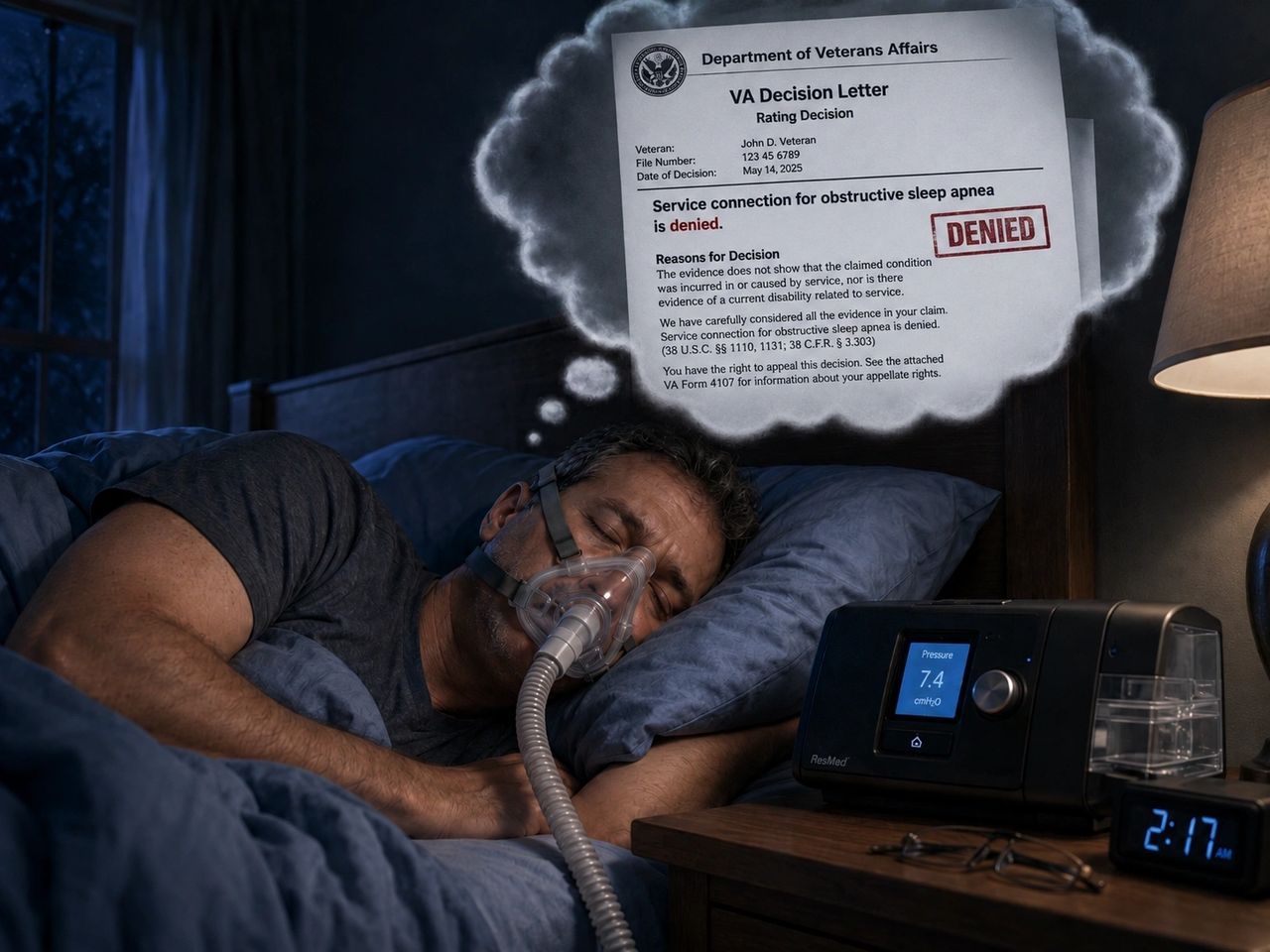

There is a solution to overcome the denial. Get a nexus letter.
Sleep Apnea Secondary to Obesity
Sleep Apnea Secondary to Obesity: VA Disability Nexus Letters for Veterans
Obesity is one of the strongest risk factors for obstructive sleep apnea. For veterans, weight gain during or after service is often not coincidental — it may trace back to a musculoskeletal injury, a psychiatric medication, a mental health condition, or a chronic pain condition that leads to deconditioning.
When weight gain is connected to a service-connected condition, and that weight gain contributes to obstructive sleep apnea, veterans may be able to establish service connection for OSA through an intermediate step theory that the VA's Office of General Counsel has recognized. This is one of the most medically nuanced sleep apnea claims veterans can file, and one where the quality of the nexus letter matters most.
At Brightview Psychiatry Solutions, our physicians provide independent medical nexus letters for veterans pursuing sleep apnea claims secondary to obesity and weight gain, including complex multi-step claims that require detailed reasoning about how a service-connected condition caused weight gain that then caused or aggravated obstructive sleep apnea.
Book an Appointment Today
The best way to determine if a nexus letter can help your claim is to discuss your case with Dr. Allen. She has years of experience successfully helping veterans achieve service-connection.
VA Denied Sleep Apnea Because of Obesity?
Ask the Question the VA May Have Missed: Who Caused the Weight Gain?
Many veterans are denied service connection for obstructive sleep apnea because the VA says the condition is "due to obesity," "due to weight gain," or "related to body habitus." But that explanation may stop too soon. The more important question is often:
If the VA blamed obesity, who or what caused the veteran to gain weight?
For many veterans, weight gain did not happen in isolation — it developed after service-connected PTSD, depression, anxiety, chronic pain, orthopedic injuries, medication side effects, fatigue, insomnia, or reduced activity began affecting daily life. At Brightview Psychiatry Solutions, Dr. Jessica Allen provides independent medical nexus letters for veterans pursuing VA disability claims for obstructive sleep apnea secondary to obesity or weight gain as an intermediate step, explaining when medically supportable how a service-connected condition contributed to weight gain, and how that weight gain contributed to OSA.
Read more about sleep apnea secondary to PTSD, where weight gain is often the intermediate step.
Sleep Apnea Secondary to Obesity: What Veterans Need to Know
Obesity is generally not treated as a stand-alone VA disability under DC 6847. However, it may still matter in a VA claim if it served as an intermediate step between a service-connected condition and obstructive sleep apnea. The claim is not simply, "I have obesity, so I should be service-connected." Instead, the claim is: "My service-connected condition contributed to weight gain, and that weight gain contributed to my obstructive sleep apnea." This distinction matters because many VA denials focus only on obesity as a risk factor, without explaining why the veteran gained weight in the first place.
See the full list of conditions veterans can claim secondary to sleep apnea.
The Intermediate Step Doctrine: How Obesity Can Connect a Service-Connected Condition to Sleep Apnea
The VA does not treat obesity itself as a separately ratable disability. However, the VA Office of General Counsel has recognized that obesity may serve as an "intermediate step" between a veteran's service-connected disability and another condition, such as obstructive sleep apnea. A veteran may support service connection when the medical evidence shows the following chain:
Step 1: A service-connected condition caused functional changes. Examples include PTSD, depression, anxiety, chronic pain, orthopedic injuries, insomnia, migraines, or medication side effects that affect sleep, activity level, metabolism, motivation, or daily functioning.
Step 2: Those functional changes caused or contributed to weight gain or obesity. This may occur through reduced activity, pain-limited movement, poor sleep, fatigue, emotional eating, medication-related weight gain, sedation, or loss of conditioning.
Step 3: The weight gain or obesity caused or aggravated obstructive sleep apnea. Excess weight can increase upper-airway narrowing, reduced lung volume, airway collapse during sleep, and worsening sleep-disordered breathing.
When these steps are supported by the veteran's medical history and explained in a physician-written nexus opinion, obesity may serve as the intermediate link. A strong nexus letter explains, in the veteran's specific case, how the service-connected condition caused or aggravated weight gain, how that weight gain contributed to obstructive sleep apnea, and why the evidence supports the connection under VA's secondary service connection framework, rather than simply stating that obesity is associated with sleep apnea. Dr. Allen evaluates each part of this chain individually — the veteran's service-connected conditions, functional limitations, weight history, sleep apnea diagnosis, and treatment records — looking for a medically supportable timeline: what changed, when the weight gain occurred relative to the service-connected condition, and whether it was medically meaningful enough to contribute to OSA.
Related reading: what to do after a denied sleep apnea claim.
Why "Obesity Caused It" May Be an Incomplete VA Opinion
VA examiners often state that a veteran's obstructive sleep apnea is "more likely due to obesity." That may be partly true, but it can still be incomplete if the examiner fails to ask whether PTSD, depression, chronic pain, orthopedic injuries, or medications contributed to reduced activity, fatigue, or increased appetite, or whether the veteran gained weight after service-connected symptoms worsened. If those questions are not addressed, the opinion may not fully analyze the veteran's medical history.
Related reading: how a spouse buddy letter can support your sleep apnea claim.
If Your OSA Claim Was Denied Due to Obesity
When the VA Cites Obesity as an Independent Cause — And What to Do
The VA frequently denies sleep apnea claims by concluding that obesity is the independent cause of the veteran's OSA, so no service connection exists — often without considering whether the obesity itself is connected to a service-connected condition. The veteran may file a Supplemental Claim within one year of the rating decision and submit a physician-written nexus letter as new and relevant evidence, directly addressing the denial reasoning rather than simply reasserting the connection. Because the one-year window from the date of the denial can affect the veteran's effective date and back pay, veterans who receive this type of denial should not delay in seeking a physician opinion.
If the VA blamed obesity in your decision, start with the steps for a denied sleep apnea claim.
What Is an OSA Nexus Letter for Obesity?
An OSA nexus letter is a medical opinion that explains whether a veteran's obstructive sleep apnea is at least as likely as not related to service or to an already service-connected condition. For sleep apnea secondary to obesity, it should address whether the service-connected condition contributed to weight gain, whether that weight gain contributed to OSA by worsening upper-airway narrowing and airway collapse, and whether the OSA would have developed or become as severe absent the service-connected condition and resulting weight gain — the intermediate-step theory, explained through the veteran's specific medical chain rather than a general association.
Learn more about Dr. Allen's background as a former VA C&P examiner.
What Compensation Could Look Like
The Financial Impact of Getting OSA Service-Connected
Most veterans with obstructive sleep apnea who require a CPAP machine receive a 50% VA disability rating. Adding a 50% OSA rating to existing service-connected conditions can be substantial, particularly for veterans already rated at 30%, 50%, or 70% for conditions like PTSD, musculoskeletal injuries, or other disabilities. The table below shows estimated monthly compensation increases using 2026 VA rates for a veteran with no dependents; veterans with spouses or dependents will receive higher amounts. Schedule a free consultation to discuss what service connection for sleep apnea could mean for your specific rating.