Author: Jessica R. Allen, M.D.| Psychiatrist and Former C&P Examiner
You can discuss your denied claim with Dr. Allen. Call (919) 849-8617 or Book a free consultation .
Reviewed: July 3, 2026
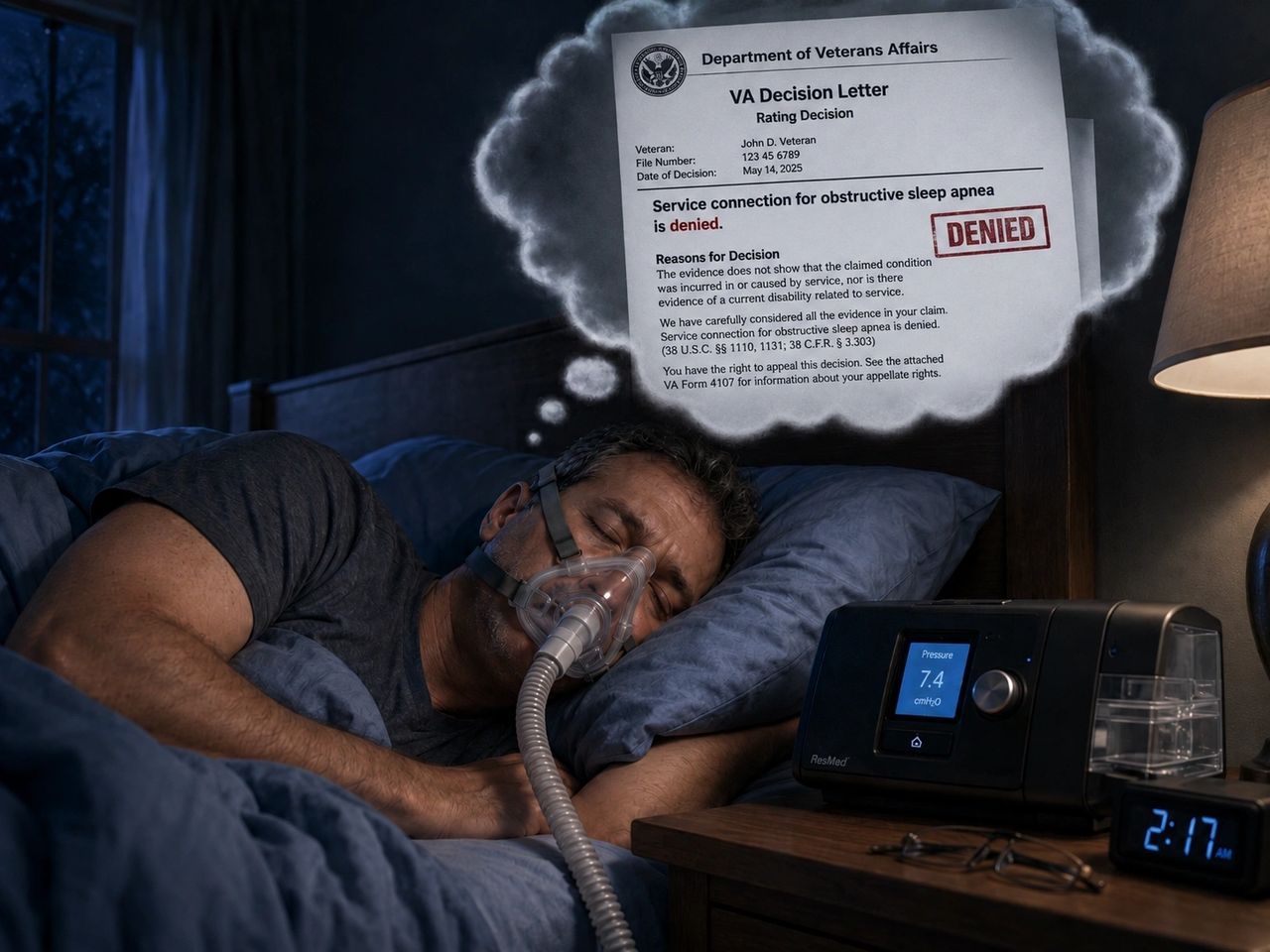
A denial is not the end of your claim. In most cases, a sleep apnea claim denied comes down to one missing piece — clear medical evidence linking your obstructive sleep apnea (OSA) to your service. A well-written nexus letter can supply that missing link and be filed as new evidence in your appeal.
Sleep apnea is one of the most commonly claimed VA disability conditions — and one of the most commonly denied. A denial usually means "not proven yet," not "not eligible." Here's how to move forward.
Step 1: Read Your Denial Letter and Understand the Rationale
Before doing anything else, find out exactly why you were denied. Your VA decision letter explains what evidence was reviewed and why — and that rationale tells you what your next piece of evidence has to accomplish.
Sleep apnea denials almost always fall into one of three buckets:
1) No medical nexus. You have a diagnosis, but nothing in your file connects your sleep apnea to your service or to a service-connected condition. This is the most common reason for denial — and exactly what a nexus letter is built to fix.
2) An unfavorable C&P exam opinion. A VA examiner wrote that your sleep apnea is "less likely than not" related to service. When that opinion is thinly reasoned or overlooks parts of your record, it can be answered with a stronger, better-supported medical opinion.
3) Blamed on weight or lifestyle. Some raters assume sleep apnea is purely the result of post-service weight gain. But if that weight gain traces back to a service-connected condition or its medications, the connection can still be established.
Pinpointing your exact reason matters: a claim denied for "no nexus" needs a different response than one denied over an unfavorable exam.
Step 2: A Well-Written Nexus Letter Is New Evidence
One of your strongest options after a denial is to file a supplemental claim (VA Form 20-0995), which requires new and relevant evidence the VA didn't already have. A fresh, physician-authored nexus letter typically qualifies — exactly what's needed to reopen a denied claim.
A strong nexus letter should do all of the following:
1) Use the VA's standard. It should state clearly that your sleep apnea is "at least as likely as not" (a 50% or greater probability) connected to your service or to a service-connected condition.
2) Give real medical rationale. It should explain the physiological "why," not just state a conclusion. A bare opinion carries little weight; a reasoned one carries a lot.
3) Cite medical literature. It should support each assertion with references the VA can verify.
4) Answer the reason you were denied. If the denial said "no nexus," the letter builds that nexus. If an examiner said "less likely than not," the letter takes on that reasoning directly.
5) Reflect your actual records. A credible opinion is grounded in your C-file, sleep study, service records, and treatment history — not a generic template.
Step 3: Know What a Rebuttal Is — and When You Need One
If your denial rested on an unfavorable Compensation & Pension (C&P) exam, another "at least as likely as not" letter alone may not be enough — a rebuttal is often needed instead.
A rebuttal answers the VA examiner directly: it reads their rationale, identifies where it's flawed, incomplete, or ignored your records, and explains — with medical evidence — why the correct conclusion favors you.
A strong rebuttal typically:
- Summarizes the examiner's exact reasoning, then addresses it point by point.
- Points out overlooked evidence, such as lay statements, in-service symptoms, or records the examiner didn't account for.
- Corrects faulty medical assumptions with current, cited literature.
- Explains why a physician's well-reasoned opinion deserves greater weight than a conclusory one.
ALREADY SUBMITTED A NEXUS LETTER AND STILL GOT DENIED?
For many veterans, the hardest denials to accept are the ones that came after they already paid for a nexus letter — and the VA still said no. Usually the problem isn't that you needed a nexus letter; it's that the one you submitted wasn't thorough enough.
This happens more often than it should. Many nexus letters are template-written, untied to your actual records, built on vague rationale, or silent on the specific reason the VA denied your claim. Some aren't even written by a physician. A letter like that can check a box without moving your case forward — and a generic letter that doesn't answer an unfavorable examiner's opinion rarely changes the outcome.
Here is what I can do: review the nexus letter that was submitted, along with the decision that denied it, and identify exactly why it fell short. Then I'll write a new, more thorough letter — individualized to your records, service history, and the VA's stated reasoning — and, when applicable, a rebuttal that answers the examiner's opinion directly.
As a physician and former C&P examiner, I can see what a prior letter missed and what the VA actually needs. The goal isn't another letter for your file — it's the right letter, addressing the exact reason you were told no.
Already denied even with a nexus letter? Let Dr. Allen review it and tell you honestly whether a stronger letter and rebuttal can help. Call (919) 849-8617 or Book a free consultation .
Step 4: Determine Whether You Have a Causation or Aggravation Claim
If you're claiming sleep apnea as secondary to another service-connected condition, two different theories apply under 38 CFR § 3.310. Getting the theory right shapes the evidence you need — the wrong one is its own path to denial.
Causation (38 CFR § 3.310(a)). A service-connected condition caused your sleep apnea to develop. You need a medical opinion tracing the pathway from the primary condition to the OSA. No "before" baseline is required, since the whole condition is on the table. Example: a service-connected knee injury limits activity, which leads to weight gain, which leads to obstructive sleep apnea.
Aggravation (38 CFR § 3.310(b)). You already had OSA, and a service-connected condition made it worse. Here you need a baseline — how severe the condition was before the aggravation — because the VA rates only the added disability. Records showing "before" and "after" severity are essential. Example: mild, controlled OSA becomes markedly worse after weight gain tied to a service-connected condition's medication.
If you're not sure which theory fits, sort that out early — the nexus letter is written differently depending on the answer.
Your Appeal Options After a Denial
Under the current VA appeals system, you generally have three lanes. Because a nexus letter counts as new evidence, most veterans in this situation are pointed toward the first.
1) Supplemental Claim (VA Form 20-0995). You reopen your case by submitting new and relevant evidence the VA didn't have — such as a nexus letter or rebuttal. This is the most common path after a sleep apnea denial.
2) Higher-Level Review (VA Form 20-0996). A senior reviewer takes a fresh look at your case. No new evidence is allowed, so this is best when you believe the VA erred with the evidence it already had.
3) Board Appeal (VA Form 10182). A Veterans Law Judge reviews your case. This is often used when the other lanes don't resolve things, and it includes options for a hearing or additional evidence.
A note on timing: you generally have one year from the date on your decision letter to file and preserve your original effective date, which determines potential back pay. You can often file later, but may lose earlier back pay. An accredited VSO, claims agent, or attorney can confirm your deadlines.
Why a Former C&P Examiner Is the Right Choice to Write Your Letter
The person who writes your nexus letter or rebuttal matters as much as the letter itself.
A physician who has sat on the VA's side of the exam. Your letter is written by Jessica R. Allen, M.D., a licensed physician and former VA C&P examiner. She has personally performed the same kind of exam that may have led to your denial, giving her firsthand insight into how these opinions are built and where weak ones break down.
A real advantage on rebuttals. Rebutting an unfavorable C&P opinion isn't about disagreeing louder — it's about understanding how the examiner reached their conclusion and showing why that reasoning doesn't hold up, within the VA's own framework.
Letters built to the standard the VA applies. Every letter is structured around what adjudicators look for: a clear "at least as likely as not" opinion, sound rationale, supporting literature, and a direct response to why your claim was denied.
Talk It Through in a Free Consultation
A denial is frustrating, but it's often just a sign that your claim needs stronger evidence. In a free phone consultation, we can look at why your sleep apnea claim was denied, whether your case is causation or aggravation, and how a physician-written nexus letter or rebuttal could serve as new evidence in your appeal.
Call: (919) 849-8617
Email: hello@brightviewMD.com
Sources and Further Reading
This article is based on official U.S. Department of Veterans Affairs guidance and federal regulations. For the most current details, review the primary sources directly:
- VA decision reviews and appeals (overview of your options after a denial) — https://www.va.gov/decision-reviews/
- Supplemental Claims (VA Form 20-0995; the "new and relevant evidence" standard) — https://www.va.gov/decision-reviews/supplemental-claim/
- Higher-Level Reviews (VA Form 20-0996; no new evidence allowed) — https://www.va.gov/decision-reviews/higher-level-review/
- Board Appeals (VA Form 10182; review by a Veterans Law Judge) — https://www.va.gov/decision-reviews/board-appeal/
- Choosing a decision review option (including the one-year filing deadline) — https://www.va.gov/resources/choosing-a-decision-review-option/
- 38 CFR § 3.310 (legal basis for causation and aggravation, including the baseline requirement) — https://www.ecfr.gov/current/title-38/chapter-I/part-3/subpart-A/subject-group-ECFR39056aee4e9ff13/section-3.310
- Plus citations to 38 CFR § 3.303 (direct service connection) and 38 U.S.C. § 5107 (the benefit-of-the-doubt standard).
Disclaimer: This article is general educational information about the VA claims and appeals process. It is not legal advice, medical advice, or a guarantee of any claim outcome. Sleep Apnea Nexus Letters and Brightview Psychiatry Solutions are private and are not affiliated with, or endorsed by, the U.S. Department of Veterans Affairs. Eligibility and results depend on your individual records and circumstances.
Related Pages
Sleep Apnea Nexus Letters: Secondary to PTSD
Sleep Apnea Nexus Letters: Secondary to Obesity
Sleep Apnea Nexus Letters: Secondary to Sinusitis
Share this post: