
Author: Jessica R. Allen, M.D., Physician and Former C&P Examiner
Sleep Apnea Secondary to GERD
VA Disability Nexus Letters for Veterans With GERD and Obstructive Sleep Apnea
Many veterans who are service-connected for gastroesophageal reflux disease, commonly known as GERD, do not realize that GERD may be relevant to a VA claim for obstructive sleep apnea. At first glance, acid reflux and sleep-disordered breathing may seem unrelated. However, medical research has increasingly recognized a meaningful relationship between GERD and obstructive sleep apnea, including evidence suggesting that the relationship can run in both directions.
If you are already service-connected for GERD and have been diagnosed with obstructive sleep apnea, you may be able to pursue a VA disability claim for sleep apnea secondary to GERD. As with any secondary service connection claim, the strength of the case depends on your individual medical evidence, symptom history, treatment records, and timeline.
At Brightview Psychiatry Solutions, our physicians provide independent medical nexus letters for veterans pursuing sleep apnea claims secondary to GERD. Each case is reviewed individually, with attention to the veteran’s medical history, GERD symptoms, sleep apnea diagnosis, treatment records, and whether the evidence supports causation, aggravation, or another medically appropriate theory.
Can Sleep Apnea Be Secondary to GERD?
The Medical Relationship Between GERD and OSA
Yes. Sleep apnea may be claimed as secondary to GERD when the medical evidence supports a connection in the veteran’s specific case.
GERD and obstructive sleep apnea are often discussed together because reflux symptoms can worsen during sleep and may affect the upper airway, breathing stability, arousals from sleep, and inflammation. Some studies have examined this relationship using Mendelian randomization, a genetic research method designed to reduce the effects of confounding factors and reverse causation.
This matters because VA examiners may sometimes dismiss a secondary claim by saying that GERD and sleep apnea are merely associated, not causally related. A well-supported nexus letter should go beyond a general association and explain how the veteran’s specific medical history supports the claimed relationship.
Why the Timeline Matters
GERD and Sleep Apnea Can Influence Each Other
One important issue in these claims is direction. Research suggests that GERD and obstructive sleep apnea may have a bidirectional relationship, meaning each condition may contribute to or worsen the other.
For a VA claim, this makes the veteran’s timeline especially important. A nexus letter should not simply state that GERD and sleep apnea are related in general. Instead, it should explain whether the veteran’s GERD symptoms appeared before the sleep apnea symptoms, whether reflux symptoms worsened over time, whether nighttime reflux was present, and whether the veteran’s sleep-related breathing symptoms became more severe in connection with GERD.
This individualized analysis is often what separates a strong nexus letter from a generic one.
VA Secondary Service Connection for Sleep Apnea Due to GERD
What Evidence Does VA Usually Need?
To support a claim for sleep apnea secondary to GERD, veterans generally need three types of evidence.
1. A Current Diagnosis of Obstructive Sleep Apnea
This is usually confirmed through a sleep study. Records may also show whether the veteran was prescribed a CPAP, APAP, BiPAP, or oral appliance.
2. A Service-Connected GERD Diagnosis
The veteran should already be service-connected for GERD or be pursuing service connection for GERD at the same time.
3. A Medical Nexus Between GERD and Sleep Apnea
The nexus letter should explain why the veteran’s obstructive sleep apnea is at least as likely as not proximately due to, the result of, and/or aggravated by service-connected GERD. The opinion should be based on the veteran’s specific records, not just a general statement that GERD and sleep apnea can be related.
Causation vs. Aggravation
Two Different Ways GERD May Support a Sleep Apnea Claim
There are two major theories that may apply in a sleep apnea secondary to GERD claim: causation and aggravation.
Causation means the service-connected GERD directly contributed to the development of obstructive sleep apnea. This theory may be stronger when GERD symptoms clearly began before sleep apnea symptoms and the medical history supports a plausible relationship.
Aggravation means GERD made an existing or developing sleep apnea condition worse. This may be the more appropriate theory when GERD and sleep apnea developed around the same time, when the timeline is less clear, or when reflux symptoms appear to worsen sleep quality, breathing disruption, or nighttime awakenings.
A strong nexus letter should evaluate both theories and explain which one is best supported by the evidence.
GERD May Not Be the Only Relevant Condition
Multiple Service-Connected Conditions Can Contribute to Sleep Apnea
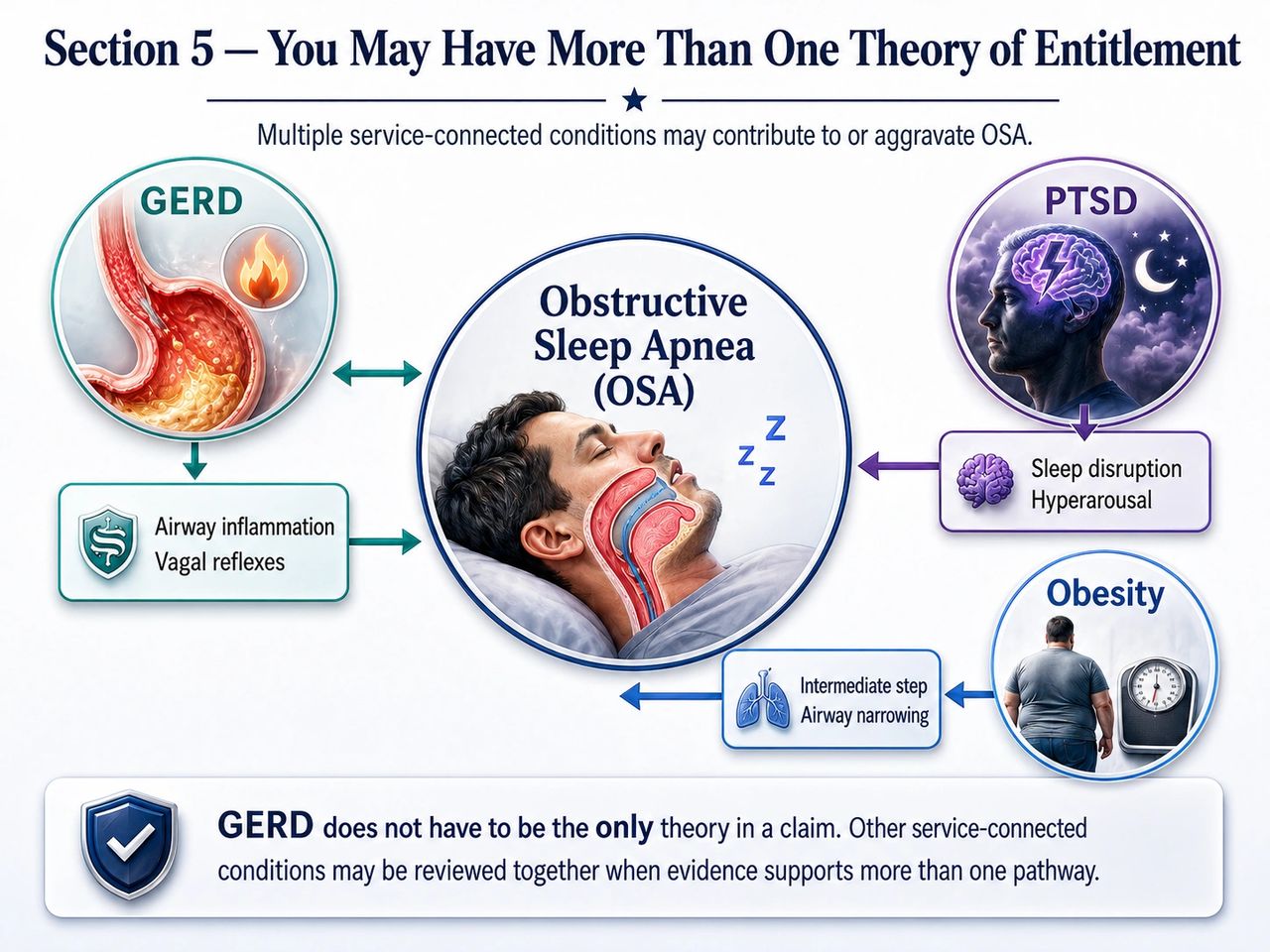 Service-Connected Conditions that can Cause and Aggravate Sleep Apnea
Many veterans have more than one service-connected condition that may be relevant to sleep apnea. GERD does not always have to be the only theory of entitlement.
For example, a veteran may be service-connected for GERD and PTSD. In that situation, the sleep apnea claim may involve more than one pathway: reflux-related airway irritation or nighttime symptoms from GERD, along with sleep disruption, hyperarousal, insomnia, or weight changes related to PTSD.
Other veterans may have GERD along with chronic pain, depression, asthma, rhinitis, sinusitis, medication side effects, or obesity as an intermediate step. When more than one service-connected condition may be contributing to sleep apnea, a nexus letter should evaluate the full medical picture rather than limiting the analysis to GERD alone.
What Service Connection for Sleep Apnea Could Mean
OSA May Affect Your Overall VA Disability Rating
For many veterans, obstructive sleep apnea can have a significant impact on monthly VA compensation if it becomes service-connected. The actual rating depends on the severity of the condition, treatment requirements, VA regulations, and how the new rating combines with the veteran’s existing service-connected disabilities.
Because VA combined ratings are not simple addition, the financial impact varies from case to case. A veteran who receives a new rating for sleep apnea may see a different compensation increase depending on their current combined rating and dependent status.
Example: adding a 50% sleep apnea rating (veteran alone, no dependents)
| Existing rating | Monthly now | With 50% OSA added | New monthly | Increase |
|---|---|---|---|---|
| 30% | $552 | Combined 65% → rounds to 70% | $1,808 | +$1,256 |
| 50% | $1,133 | Combined 75% → rounds to 80% | $2,102 | +$969 |
| 70% | $1,808 | Combined 85% → rounds to 90% | $2,362 | +$554 |
Figures are illustrative examples based on current VA compensation rates for a veteran with no dependents. Your actual amount depends on your combined rating, dependents, and effective date.
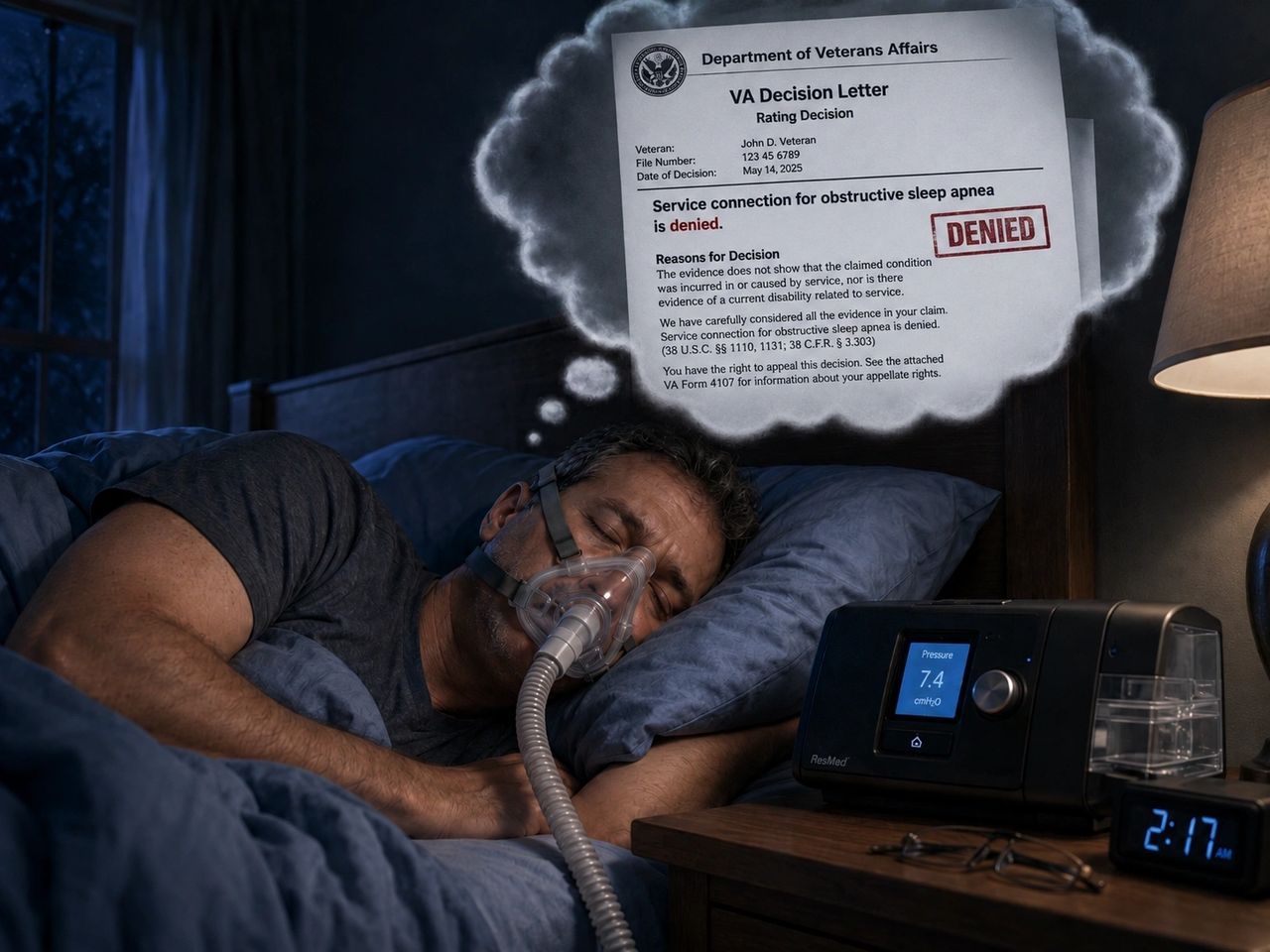
If Your Sleep Apnea Claim Was Denied
Common Reasons VA Denies OSA Secondary to GERD Claims
VA may deny sleep apnea secondary to GERD for several reasons. Common denial rationales include:
- VA acknowledges both GERD and sleep apnea but finds no medical nexus
- VA attributes sleep apnea to obesity, age, anatomy, or other risk factors
- The examiner concludes GERD and OSA are unrelated
- The prior nexus opinion relied on a generic association rather than individualized analysis
- The opinion did not address the veteran’s symptom timeline
- The opinion failed to discuss aggravation separately from causation
- The denial did not fully consider nighttime reflux symptoms or worsening sleep-related breathing symptoms
If your claim was denied, a physician-written nexus letter may help by directly addressing the VA’s reasoning and explaining how your records support the claimed relationship.
Supporting Evidence for Sleep Apnea Secondary to GERD
What to Gather Before Your Consultation
The most helpful evidence is documentation that shows your GERD diagnosis, sleep apnea diagnosis, treatment history, and symptom timeline.
GERD Evidence
- VA rating decision showing GERD is service-connected
- Primary care or gastroenterology records
- Documentation of reflux symptoms
- Records showing nighttime reflux, coughing, choking, regurgitation, or throat irritation
- Medication history, including proton pump inhibitors, H2 blockers, antacids, or other reflux treatments
- Timeline of when GERD symptoms began compared with sleep apnea symptoms
Sleep Apnea Evidence
- Sleep study results
- CPAP, APAP, BiPAP, or oral appliance prescription
- PAP compliance reports, if available
- Records showing snoring, choking, gasping, witnessed apneas, fatigue, or daytime sleepiness
- Documentation of worsening sleep symptoms over time
Lay Statements
Statements from a spouse, partner, roommate, family member, or fellow service member may help establish a timeline. These statements can describe nighttime reflux, coughing, choking, gasping, interrupted sleep, witnessed breathing pauses, fatigue, irritability, or changes in functioning.
Why a Generic Nexus Letter May Not Be Enough
The Claim Needs a Timeline-Driven Medical Analysis
A generic nexus letter that simply states “GERD and sleep apnea are related” may not be enough to support a VA claim. Because GERD and obstructive sleep apnea can influence each other, the letter should explain why the veteran’s specific history supports the claimed direction of causation or aggravation.
A thorough nexus letter should review the veteran’s medical records, sleep study findings, GERD treatment history, medication history, lay evidence, and symptom timeline. It should also address other risk factors, such as obesity or age, when they are relevant.
The goal is not to ignore competing explanations. The goal is to explain why, despite those factors, it remains at least as likely as not that service-connected GERD caused or aggravated the veteran’s obstructive sleep apnea when the evidence supports that conclusion.
Why Choose Brightview Psychiatry Solutions?
Physician-Written Nexus Letters for Veterans
Dr. Jessica Allen is a physician and former VA Compensation and Pension examiner with experience reviewing veterans’ medical records and preparing independent medical opinions for VA disability claims.
At Brightview Psychiatry Solutions, we do not use one-size-fits-all nexus letters. Our physicians review the veteran’s individual medical history, service-connected conditions, symptom timeline, treatment records, and VA denial reasoning when applicable.
For sleep apnea secondary to GERD, this means evaluating whether the evidence supports causation, aggravation, or a combined theory involving multiple service-connected conditions.