By Jessica R. Allen, M.D. | Brightview Psychiatry Solutions | sleepapneanexusletter.com
If you are a veteran with a service-connected traumatic brain injury (TBI) and have been diagnosed with central sleep apnea (CSA), you may be entitled to additional VA disability compensation through a secondary service connection claim. This guide explains the medical relationship between TBI and central sleep apnea, how the VA evaluates these claims, and what evidence you need to win.
If you would like to discuss your case with Dr. Allen, please book a free phone consultation at this Book a free consultation .
What Is Central Sleep Apnea?
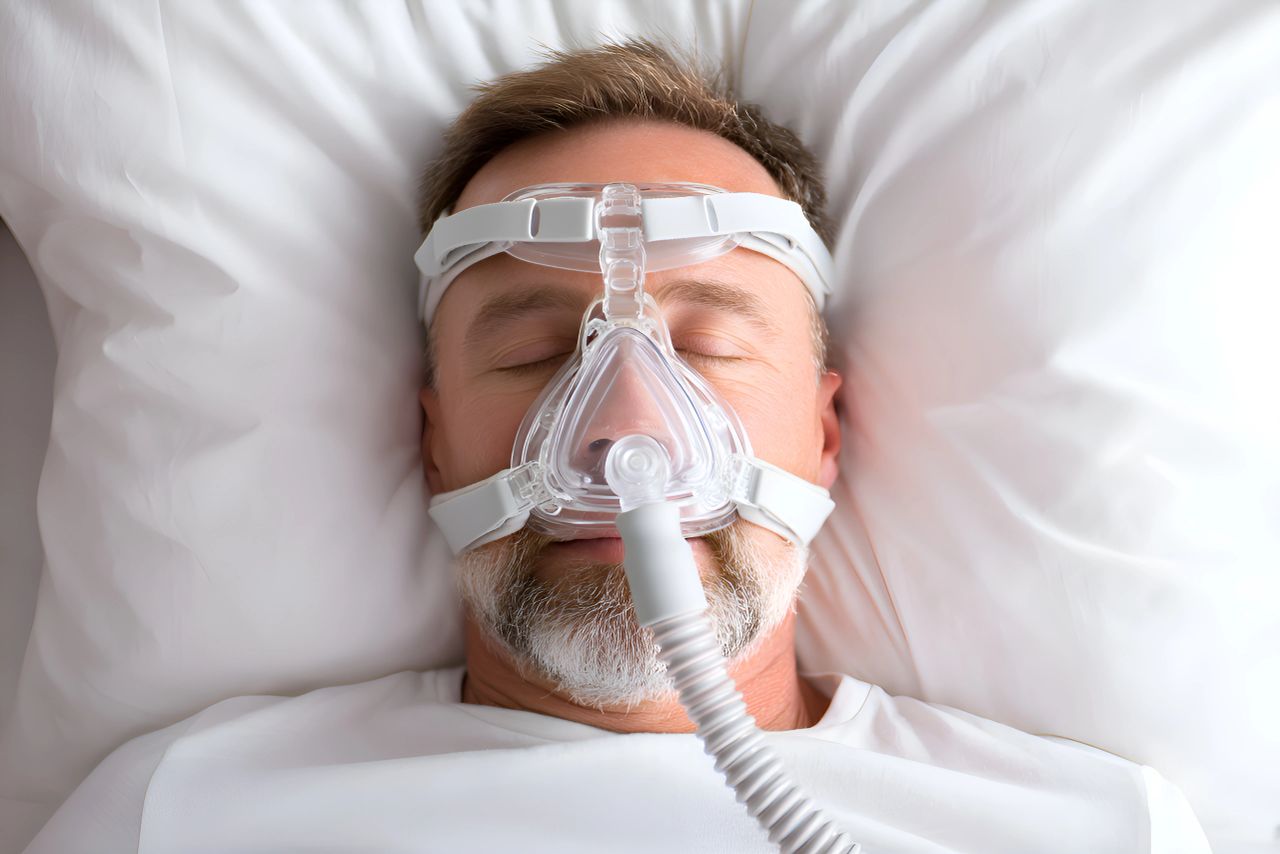
Central sleep apnea (CSA) is a sleep disorder in which breathing repeatedly stops during sleep — not because of a physical airway blockage, but because the brain fails to send the proper signals to the muscles that control breathing. This distinguishes CSA from obstructive sleep apnea (OSA), where the airway itself is physically blocked.
In CSA, the brainstem — which regulates automatic breathing during sleep — fails to maintain consistent respiratory drive, causing repeated pauses in breathing that fragment sleep, reduce oxygen levels, and prevent restorative rest.
Symptoms of central sleep apnea include:
- Repeated awakenings during the night
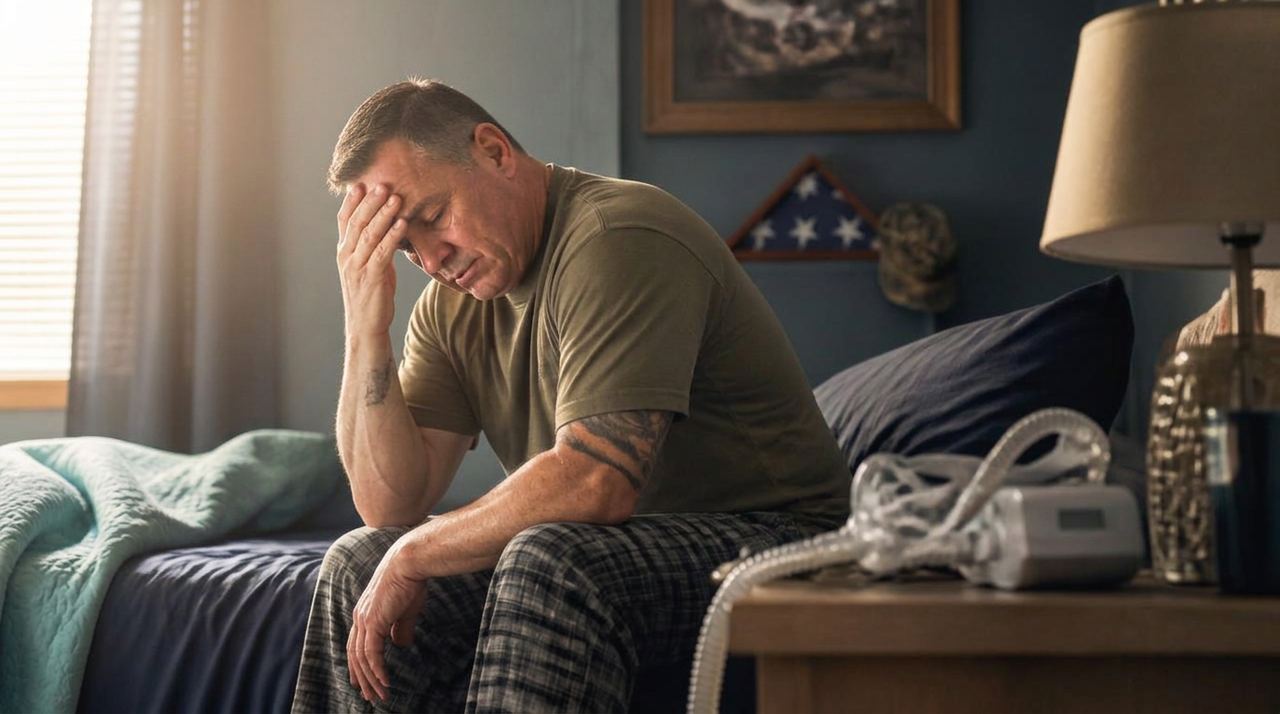
- Non-restorative sleep and chronic fatigue
- Daytime sleepiness and cognitive difficulties
- Difficulty concentrating and memory impairment
- Mood changes, depression, and anxiety
- Morning headaches
- Witnessed episodes of stopped breathing during sleep
What Is Traumatic Brain Injury (TBI)?
Traumatic brain injury occurs when a sudden trauma causes damage to the brain. In the military context, TBI most commonly results from blast exposure, motor vehicle accidents, falls, or blunt-force impact. TBI is classified by severity:
- Mild TBI (mTBI / concussion): Brief or no loss of consciousness, post-traumatic amnesia of less than 24 hours, GCS score of 13–15
- Moderate TBI: Loss of consciousness from 30 minutes to 24 hours, post-traumatic amnesia of 1–7 days
- Severe TBI: Loss of consciousness greater than 24 hours, post-traumatic amnesia greater than 7 days
TBI's effects extend beyond the initial injury: damage to the brainstem, hypothalamus, and other regions involved in respiratory regulation can persist for years and directly cause or contribute to central sleep apnea.
The Medical Link Between TBI and Central Sleep Apnea
The relationship between TBI and central sleep apnea is supported by peer-reviewed literature and is mechanistically well-explained, and understanding it is essential to a successful secondary service connection claim.
How TBI Causes Central Sleep Apnea
The brain structures most involved in respiratory control during sleep include the brainstem (medulla and pons), hypothalamus, and the pathways coordinating automatic breathing. TBI can damage these structures directly or disrupt the networks carrying respiratory signals. Mechanisms linking TBI to CSA include:
1. Brainstem Injury The brainstem houses the respiratory control centers that maintain breathing rhythm. Injury — even subconcussive blast exposure — can impair the automatic respiratory drive that prevents apnea, producing central apneas.
2. Hypothalamic Dysfunction The hypothalamus regulates circadian rhythms, autonomic function, and sleep architecture. TBI-related damage can disrupt sleep-wake cycles and hormones, contributing to CSA.
3. Chemoreceptor Disruption Central chemoreceptors monitor carbon dioxide levels and trigger breathing. TBI can impair this sensitivity, causing unstable breathing during sleep-stage transitions that manifests as CSA.
4. Neuroinflammation and White Matter Damage TBI triggers neuroinflammation and diffuse axonal injury to white matter tracts, impairing the coordinated signaling required for stable breathing.
5. Post-TBI Hormonal Changes TBI is associated with hypopituitarism, which can alter hormones influencing sleep architecture and respiratory stability — a recognized contributor to sleep-disordered breathing.
What the Research Shows
Published research documents a high prevalence of sleep-disordered breathing, including CSA, in veterans and civilians with TBI:
- Veterans with moderate-to-severe TBI have significantly elevated rates of sleep-disordered breathing compared to the general population
- Even mild TBI (concussion) is associated with increased rates of sleep disturbance and sleep-disordered breathing
- TBI severity and sleep apnea prevalence are dose-dependent — more severe TBI is associated with higher rates and greater severity
- Sleep disturbances following TBI often persist for years and are frequently underdiagnosed
- Treatment of post-TBI sleep apnea can improve cognitive function, mood, and quality of life, supporting the biological connection between the two conditions
This evidence supports secondary service connection for veterans with both conditions.
VA Secondary Service Connection: The Legal Framework
Secondary service connection, governed by 38 CFR 3.310, entitles a disability proximately due to, resulting from, or aggravated by a service-connected condition to its own service connection.
To establish secondary service connection for CSA based on a service-connected TBI, you must demonstrate:
- A current diagnosis of central sleep apnea — typically confirmed by polysomnography (sleep study)
- An existing service-connected traumatic brain injury
- A medical nexus opinion establishing that the CSA is at least as likely as not caused or aggravated by the service-connected TBI If you would like to discuss getting a nexus letter, please book a free phone consultation at this Book a free consultation .
You need not prove CSA began in service or appears in service treatment records — only that your service-connected TBI caused or aggravated it.
The "At Least As Likely As Not" Standard
The VA applies a benefit-of-the-doubt standard under 38 USC 5107(b): when evidence is in approximate balance, the veteran wins. Proof beyond a reasonable doubt or by a preponderance is not required; equipoise is sufficient.
A well-supported medical nexus opinion stating that CSA is "at least as likely as not" caused or aggravated by service-connected TBI satisfies this standard.
What Evidence You Need to Win
Building a successful claim requires assembling several categories of evidence.
1. Diagnosis of Central Sleep Apnea
You need an objective diagnosis confirmed by a sleep study documenting central (not just obstructive) apneas, your AHI, and the central-versus-obstructive breakdown. If you lack a recent sleep study, obtain one — the CSA/OSA distinction matters clinically and legally.
2. Service-Connected TBI Rating
Your TBI must be service-connected; if not, establish that connection first or pursue both claims simultaneously. Gather service treatment records, deployment records of blast exposure or head injury, and any documentation of concussion or loss of consciousness.
3. A Private Medical Nexus Opinion
This is the most critical piece of evidence in a secondary service connection claim. A private nexus opinion from a qualified physician — ideally a psychiatrist, neurologist, or sleep medicine specialist with experience in TBI — should:
- Identify your specific TBI and its documented effects
- Explain the pathophysiological mechanisms by which TBI can cause or aggravate CSA
- Review your clinical history, including the timeline of TBI and CSA onset
- Reference applicable peer-reviewed medical literature
- State explicitly that your CSA is at least as likely as not caused or aggravated by your service-connected TBI
- Address any VA denial language or contrary evidence
A private nexus opinion is typically far more detailed and veteran-favorable than a C&P examination opinion. Do not rely solely on the C&P examiner to establish nexus.
4. Lay Evidence
Statements from family, friends, or fellow service members documenting changes in your sleep, cognition, and health are admissible and persuasive when corroborated by medical records.
5. Buddy Statements from Fellow Service Members
Fellow veterans who witnessed your blast exposure, head injury, or post-TBI symptoms can help establish both the occurrence of TBI and subsequent functional changes.
6. Treatment Records
Gather records related to TBI treatment, neurology follow-up, sleep study, CPAP/ASV therapy, and mental health treatment. Documented fatigue, cognitive complaints, and sleep disturbances strengthen the TBI-CSA connection.
If you would like to discuss your case with Dr. Allen, please book a free phone consultation at this Book a free consultation .
Common Reasons the VA Denies CSA Secondary to TBI Claims
Understanding common denial reasons helps you build evidence to overcome them.
Inadequate nexus: The most common denial reason is lacking a medical opinion linking CSA to TBI. C&P examiners frequently provide inadequate or negative opinions — a private nexus opinion is the solution.
Misclassification of apnea type: VA may have diagnosed OSA instead of CSA, or approved OSA without recognizing a CSA component. Review your sleep study to confirm the correct diagnosis is documented.
Failure to apply secondary theory: Veterans sometimes file on a direct basis when a secondary theory is more appropriate and better supported. If your direct claim was denied, a secondary claim may succeed.
No in-service documentation: VA may deny because CSA was not documented in service records. Secondary service connection requires a nexus to a service-connected condition, not in-service documentation — a strong private nexus opinion addresses this directly.
Obesity as an alternative cause: VA may argue obesity caused your sleep apnea. Obesity is a risk factor for OSA, not a primary cause of CSA, and a qualified expert can distinguish the mechanisms and address TBI's role.
How a Private Nexus Letter Helps
A private nexus letter — also called a medical opinion or IMO — is written by a qualified physician to establish the medical connection between your service-connected TBI and your central sleep apnea.
At sleepapneanexusletter.com, Dr. Jessica R. Allen, M.D. provides private nexus opinions for veterans seeking secondary service connection for sleep apnea and related psychiatric conditions. Dr. Allen is an Adult and Addiction Psychiatrist with an M.D. from Eastern Virginia Medical School, a four-year psychiatry residency, and a one-year Addiction Psychiatry Fellowship, with extensive experience preparing medically detailed, legally targeted nexus opinions grounded in peer-reviewed literature.
A strong nexus letter for CSA secondary to TBI will:
- Review all relevant records, including sleep studies, TBI documentation, and treatment history
- Explain the specific mechanisms by which your TBI caused or aggravated your CSA
- Address any prior VA denial and explain why the secondary theory applies
- Cite applicable peer-reviewed literature
- Provide a clear, unambiguous "at least as likely as not" opinion
- Be written to satisfy the evidentiary standards VA raters and Board judges apply
If you would like to discuss your case with Dr. Allen, please book a free phone consultation at this Book a free consultation .
The Claims Process: Step by Step
Step 1: Confirm your TBI is service-connected, or establish it first or concurrently with your CSA claim.
Step 2: Obtain a sleep study confirming CSA, specifying central apneas and AHI. A new study may be needed if the prior one only documented OSA.
Step 3: Gather your TBI records — in-service documentation of head trauma, blast exposure, or concussion, plus post-service neurology notes, neuropsychological testing, and imaging.
Step 4: Obtain a private nexus opinion establishing that your CSA is at least as likely as not caused or aggravated by your service-connected TBI.
Step 5: File a supplemental claim or new claim. Submit VA Form 20-0995 (Supplemental Claim) if you previously filed and were denied, along with your nexus letter and all supporting evidence. If this is a new claim, file VA Form 21-526EZ.
Step 6: Submit lay statements from family, friends, and fellow service members describing changes in your sleep and health following your TBI.
Step 7: Attend the C&P examination prepared — be thorough and specific about your symptoms, bring your private nexus opinion, and do not minimize your symptoms.
VA Ratings for Central Sleep Apnea
Central sleep apnea is rated under the same diagnostic code as obstructive sleep apnea — Diagnostic Code 6847 (Sleep Apnea Syndromes). The ratings are:
- 0%: Asymptomatic but with documented sleep disorder breathing
- 30%: Persistent daytime hypersomnolence
- 50%: Requires use of a breathing assistance device such as CPAP or ASV
- 100%: Chronic respiratory failure with carbon dioxide retention, cor pulmonale, or requires tracheostomy
Most veterans requiring CPAP or ASV therapy qualify for the 50% rating; persistent hypersomnolence despite treatment may support a 30% rating. Secondary conditions such as MDD, anxiety, cognitive impairment, or hypertension may each be separately ratable.
Summary
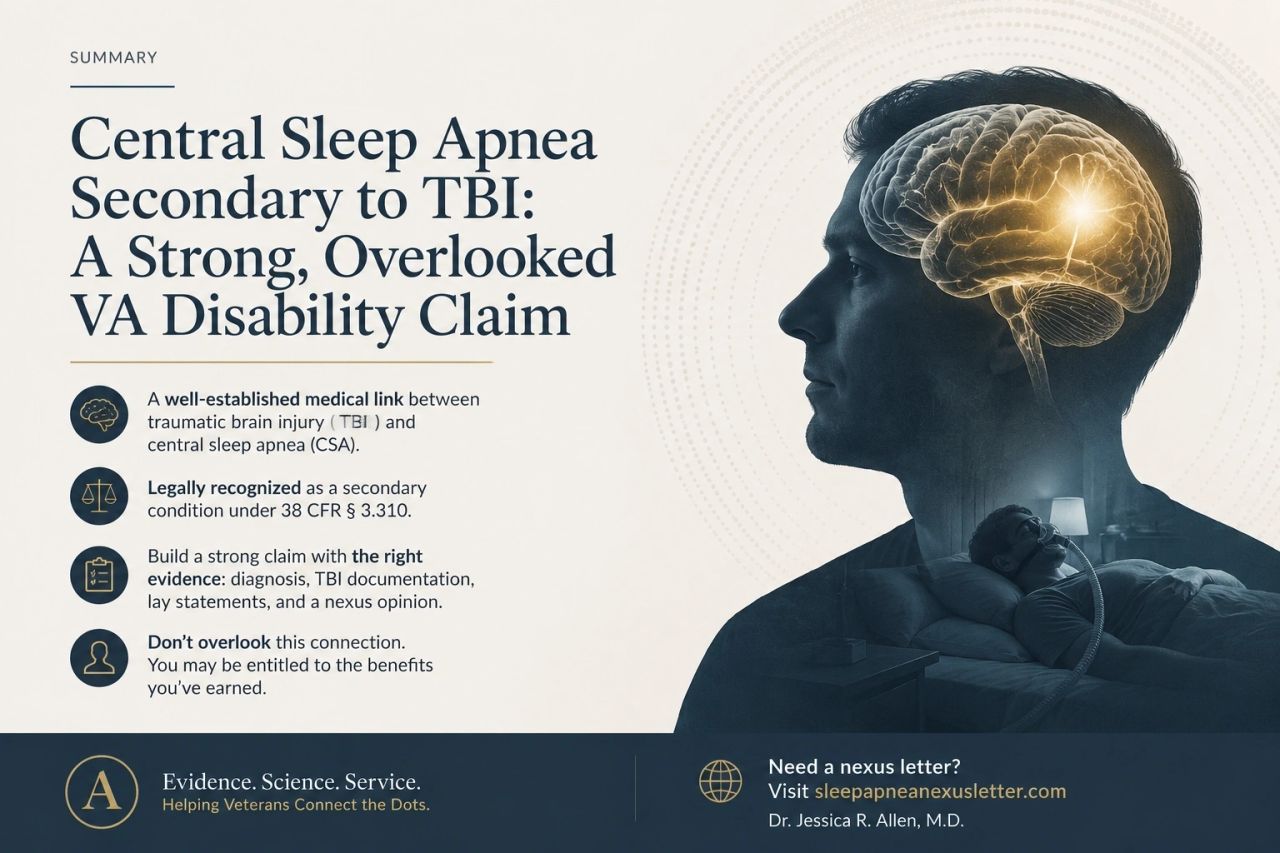
Central sleep apnea secondary to traumatic brain injury is a legitimate, well-supported claim that many veterans overlook. The relationship is mechanistically sound, supported by peer-reviewed research, and legally cognizable under 38 CFR 3.310. Veterans with CSA and a service-connected TBI should pursue this claim with a complete evidence package: a confirmed CSA diagnosis, TBI documentation, lay evidence, and — most importantly — a private medical nexus opinion from a qualified physician.
If you need a nexus letter for central sleep apnea secondary to TBI, or for any other secondary service connection claim involving sleep apnea, contact Dr. Jessica R. Allen, M.D. at sleepapneanexusletter.com.
This blog post is intended for informational purposes only and does not constitute legal or medical advice. Veterans should consult with a qualified VA-accredited attorney, claims agent, or Veterans Service Organization representative regarding their specific claims. Medical opinions for VA purposes should be prepared by a licensed physician who has reviewed the veteran's individual records.
Share this post: